
Your business may offer the best service on the block and still lose customers to a competitor with more Google Maps reviews. The issue is not always quality. Very often, it is visibility.
Today, Google Maps reviews are one of the strongest trust signals people check before making a local buying decision. Yet many businesses make mistakes that do not only fail to generate new reviews, but also put existing ones at risk or even trigger penalties that hurt visibility.
This article answers three key questions: why reviews matter for local rankings, which practices are prohibited, and which strategies actually work within the rules.
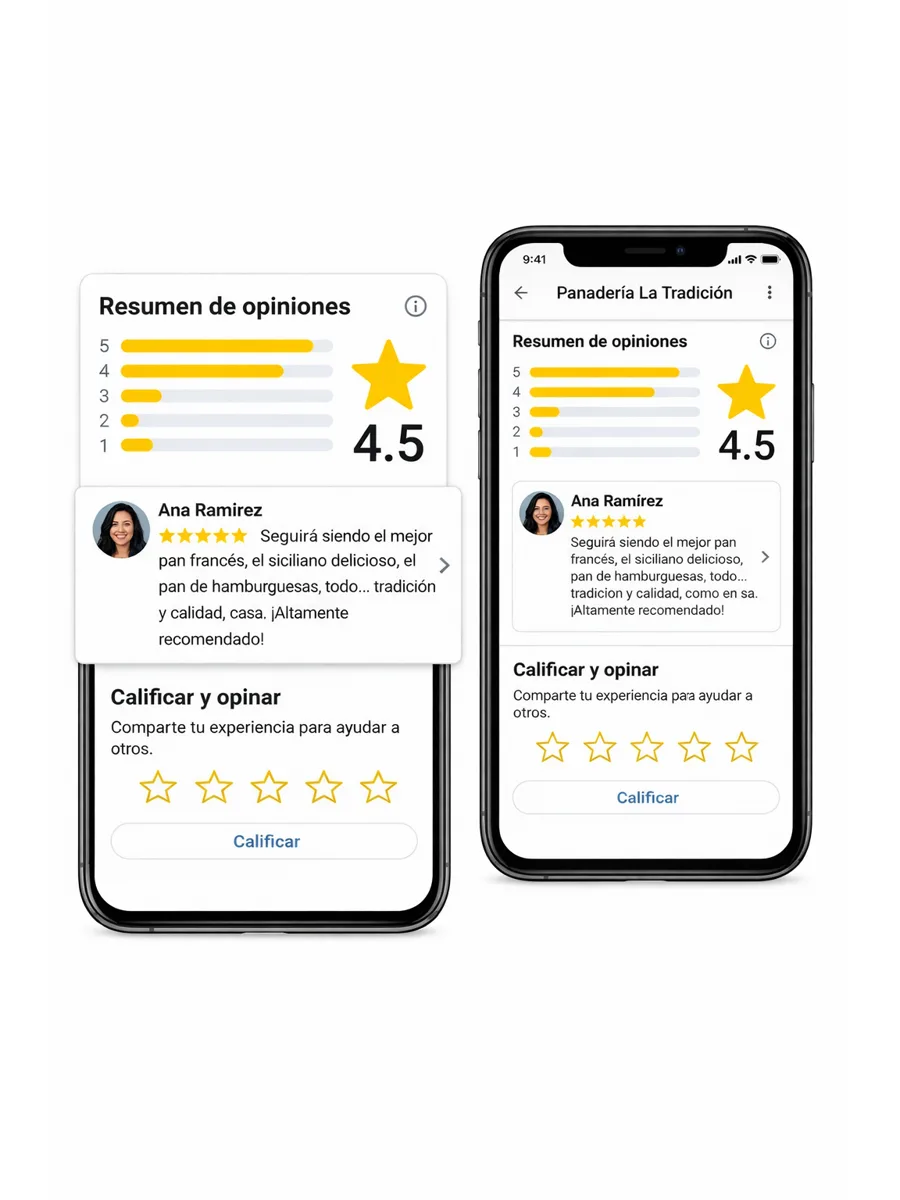
Why Google Maps reviews are a strategic asset
Google relies mainly on three local ranking factors: relevance, distance, and prominence. Reviews influence all three.
Industry-wide research also consistently shows that a large majority of users read reviews before choosing a local business. In practice, that makes reviews a core part of commercial visibility rather than a secondary detail.
There is another important nuance. Review volume often matters more than a nearly perfect rating with very few reviews. A business with a broad and active review base can often compete more effectively in local search than a profile with very limited activity.
Key insight
Reviews also create semantic signals that Google can use in AI-powered search experiences. Phrases like “fast service in Palermo” or “great sushi in Belgrano” help describe your business in real customer language.
In the context of local businesses in Argentina, this matters even more. Many users rely on Maps to validate everything from restaurants to professional services, so a strong review base can become a competitive advantage that is hard to catch up with later.
What Google prohibits: the most expensive mistakes
Before discussing tactics, it is important to understand the boundaries. Google has tightened review policies, and violations can now affect not only the reviews themselves but also the business profile.
The most serious consequences include:
- Temporary blocking: the profile cannot receive new reviews for a period of time.
- Mass removal: multiple existing reviews may be unpublished.
- Public warning: Google may show a visible notice explaining that fake reviews were removed.
Practices prohibited under Google policies
Google’s user-contributed content policy is fairly explicit. Practices you should avoid include:
- Offering incentives such as discounts, gifts, or payments in exchange for posting, editing, or removing a review.
- Asking only happy customers for reviews. Requests must be neutral if you choose to make them.
- Using employees, relatives, or partners when there is a conflict of interest.
- Posting from multiple accounts to manipulate the rating.
- Buying reviews or using artificial services to generate them.
- Discouraging negative reviews or trying to suppress them.
Important in Argentina
Buying Google Maps reviews does not only put your profile at risk with Google. It can also raise broader consumer-protection and misleading-advertising concerns.
Google detects suspicious patterns through signals that are not visible to business owners: account history, publishing velocity, geographic consistency, and abnormal rating behavior, among others.
“Google allows businesses to ask for reviews. What it forbids is filtering who can leave them and shaping what they should say.”
Strategies that work: how to earn reviews without risk
The good news is that Google does allow businesses to ask for reviews. The condition is that requests must remain neutral, directed to real customers, and free from incentives.
1. The direct review link
Creating a direct link to the review form and sharing it by WhatsApp or email after a completed service is often one of the most effective tactics. Timing matters, and the best window is usually right after the experience.
2. QR code at the point of sale
A visible QR code at the counter, on a receipt, or on a printed card turns the end of the customer journey into a natural review opportunity without pressure.
3. Post-service follow-up
A short message 24 to 48 hours later, with neutral wording such as “We’d love to hear about your experience, you can leave your feedback here,” tends to work better than aggressive or overly promotional requests.
4. Respond to every review
Replying to both positive and negative reviews is a signal of active management and professionalism. In many cases, a thoughtful response to criticism builds more trust than several positive reviews with no engagement.
How to ask for a review without breaking the rules
The difference between a legitimate practice and a risky one is often just the framing. These simple rules help:
- Allowed: “We’d love to hear about your experience.”
- Allowed: “You can leave your feedback on Google here.”
- Allowed: sending the same request to all customers.
- Not allowed: asking specifically for a five-star review.
- Not allowed: offering discounts for positive feedback.
- Not allowed: filtering unhappy customers before sending the request.
Consistency as a long-term strategy
Google is often skeptical of artificial spikes. The real goal should not be to collect a huge burst of reviews in a few days, but to build a steady and organic flow over time.
For many local businesses in Argentina, especially in highly competitive categories, that consistency can be crucial for entering or holding a position in the Local Pack, the highlighted local results block in Google search.
Frequently asked questions about Google Maps reviews
Why do legitimate reviews sometimes disappear?
Google uses automated systems to detect suspicious behavior. A legitimate review may still be removed if the account is very new, posts too many reviews too quickly, or shows unusual activity patterns.
Can I remove a negative review?
Only if it violates Google policies, such as spam, false content, offensive language, or conflict of interest. A critical but genuine review is usually not removable.
How many reviews does it take to improve local rankings?
There is no fixed number because quality, frequency, and business responsiveness also matter. Still, a stronger and more consistent review base usually creates a clear advantage over nearly empty profiles.
Can I ask a customer to edit or delete a negative review?
You can try to solve the issue privately. If the customer is satisfied afterward, they may choose on their own to update or remove the review. What you should not do is offer any incentive in return.
Before you leave this guide, review your current situation
If you manage a local business in Argentina, these actions are worth taking today:
- Create your direct review link and keep it ready.
- Review internal processes to make sure nobody is offering incentives.
- Make sure every existing review has a response.
- Confirm that your name, address, and phone number match across all channels.
- Build a consistent neutral review-request process for real customers.
If you want to turn this into a more structured growth strategy, you can explore our Google Maps optimization service.
